

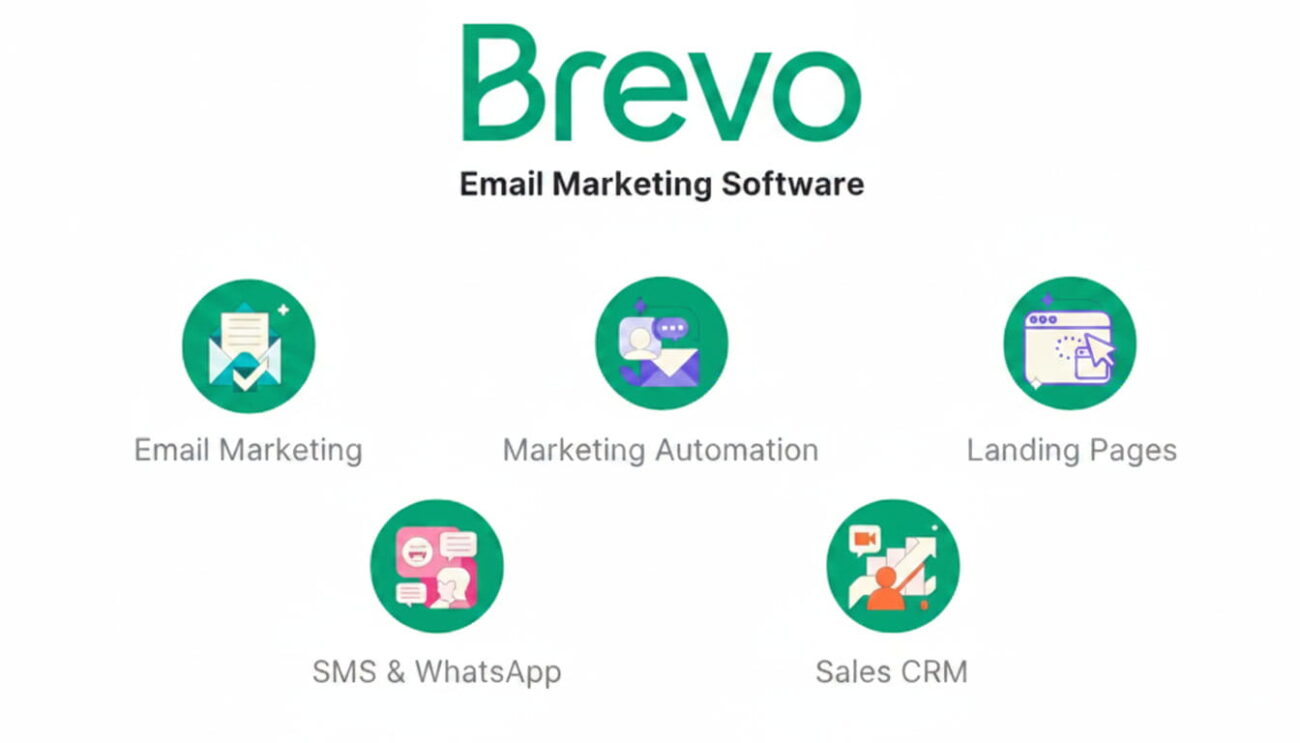
There are tools that simply help you send emails. And then there are tools that quietly change the rhythm of your business.
Brevo in 2026 feels a little like that rare companion who enters a crowded room, says very little, and still somehow makes everything easier. In a digital world swollen with dashboards, tabs, pop-ups, and promises, Brevo does something strangely powerful—it gives time back. Not in dramatic fireworks. Not in loud, over-polished slogans. Just in the small moments that matter. A campaign built faster. A customer followed up automatically. A sales lead remembered before it grows cold.
For small businesses, creators, agencies, and founders wearing five different hats before lunch, time has become the most expensive currency. Every extra click feels like sand slipping through your fingers. That is where Brevo has earned attention. What began years ago as Sendinblue has matured into something broader: an email platform, a CRM, an automation engine, a transactional messaging hub, and a customer communication system stitched together with surprising elegance.
But beauty in software can be deceptive.
Brevo saves time—yes. It removes friction—absolutely. Yet under its polished surface, there are corners where frustration still hides. Some limitations only appear after the honeymoon phase ends. Some trade-offs matter more than the sales page admits.
This Brevo review 2026 is not built on marketing glitter. It is built on the lived texture of what happens when you use the platform day after day. We will walk through 10 powerful benefits that make Brevo genuinely compelling, and we will also uncover 4 hidden downsides that deserve your attention before you commit.
Because sometimes the best software is not the loudest one.
Sometimes it is simply the one that lets you breathe.
The Quiet Rise of Brevo in 2026
The marketing software world has become a carnival of excess.
Every platform promises to be the “all-in-one revolution.” Every landing page shines with impossible certainty. More features. More AI. More integrations. More everything. And yet, buried under all that abundance, many businesses feel poorer—not in money, but in attention.
That is why Brevo’s rise in 2026 feels so interesting.
It did not conquer the market by becoming the flashiest name in the room. It grew because it understood a truth many software companies forgot: people do not buy tools because they love tools. They buy tools because they want fewer headaches.
Brevo has positioned itself in a rare middle ground. It is more capable than basic email platforms, but less intimidating than heavyweight enterprise systems. For businesses caught between “too small for complexity” and “too ambitious for simple newsletters,” that middle ground feels almost sacred.
Its growth also mirrors a wider shift in digital marketing. Businesses no longer want five disconnected products just to send campaigns, track leads, automate follow-ups, and manage customer messages. The modern workflow demands connectedness. A customer clicks an email, opens a chat, receives a transactional confirmation, and enters a sales pipeline—all in one living journey.
Brevo understands that journey.
Industry data from recent market reporting shows that businesses increasingly favor consolidated martech stacks because fragmented tools can waste hours every week. Those lost hours rarely look dramatic. They appear as tiny interruptions: exporting contacts, fixing sync errors, updating fields twice, checking if one app actually spoke to another. That invisible labor drains momentum.
Brevo’s quiet rise happened because it attacks that invisible labor.
It does not promise miracles. It promises fewer interruptions.
And in 2026, that promise may be more valuable than any shiny feature list.
Why Marketers Are Leaving Complexity Behind
There is a strange fatigue spreading through modern marketing.
It is not creative fatigue. It is not even budget fatigue. It is tool fatigue.
Marketers today often spend more time managing software than creating campaigns. One platform stores contacts. Another runs automation. Another sends transactional emails. Another manages sales notes. Another handles chat. The result is not efficiency. It is fragmentation dressed as sophistication.
That is precisely where Brevo has found emotional resonance.
In 2026, marketers are no longer blindly chasing “more advanced.” They are chasing clarity. A clean workflow has become more seductive than a thousand advanced features nobody uses.
Think about the psychology of daily work. When your system feels heavy, every campaign starts with resistance. Open tab. Check sync. Fix segment. Verify automation. Confirm CRM field. Suddenly the simple act of emailing your audience becomes a small bureaucratic battle.
Brevo softens that battle.
Its appeal is not merely functional—it is emotional. It reduces the invisible dread that builds before repetitive marketing tasks. That matters more than many reviews acknowledge.
A growing number of businesses are realizing that complexity often masquerades as professionalism. But complexity does not always create results. Often, it only creates delay.
A founder launching a new product does not want twelve setup screens. A small agency managing multiple clients does not want to wrestle with three disconnected dashboards. A local business does not want a platform that requires a mini-certification just to build an automation.
They want movement.
They want momentum.
They want a system that feels like opening a window instead of entering a maze.
That is why marketers are leaving complexity behind. Not because they suddenly became less ambitious—but because they finally understood that speed, clarity, and consistency often outperform sophistication.
And Brevo, perhaps more quietly than its competitors, speaks that language very well.
Who Brevo Is Really Built For
Not every platform belongs to everyone.
That truth becomes clearer the longer you work in digital marketing. Some tools are built for enterprises with dedicated ops teams. Some are built for hobbyists sending occasional newsletters. Brevo lives in a very particular sweet spot, and understanding that sweet spot matters before you buy.
Brevo feels most natural for people whose businesses are growing faster than their systems.
It is for the founder who still answers support emails but now has enough customers to need automation. It is for the ecommerce shop owner whose order confirmations, abandoned cart nudges, and promotional campaigns must all work together. It is for agencies juggling client communication while trying not to drown in disconnected software.
Brevo is especially attractive to businesses that want real capability without enterprise heaviness.
That distinction matters.
A large corporation may eventually outgrow Brevo’s simpler architecture. But a small or mid-sized business may find that same simplicity liberating. Instead of wrestling with overbuilt infrastructure, they can focus on actual communication.
There is also something quietly practical about Brevo’s pricing logic. Because it often prices based on email volume rather than pure contact count, it can feel kinder to businesses with large lists but selective sending habits. That makes it especially appealing for brands that care about segmentation rather than constant blasting.
Who is Brevo not perfect for?
Probably organizations needing ultra-deep customization, highly advanced attribution systems, or sprawling enterprise workflow governance. Those businesses may eventually feel the edges.
But for the people standing in that fertile middle ground—serious enough to need structure, lean enough to resent unnecessary complexity—Brevo feels like a bridge.
And sometimes a bridge is exactly what growth needs.
Not a monument.
Not a cathedral.
Just something sturdy enough to carry you forward.
Benefit #1–#3: Time-Saving Tools That Feel Almost Magical
Time rarely disappears in dramatic ways.
It leaks.
A minute lost adjusting segments. Three minutes hunting for a contact. Ten minutes rebuilding an email that should have taken two. By evening, those fragments gather like fallen leaves, and suddenly an entire afternoon has vanished.
That is where Brevo’s greatest strength begins to reveal itself. Not in spectacle, but in the quiet economy of motion.
The reason many users stay with Brevo in 2026 is not because every feature is revolutionary. It is because many daily tasks become lighter. The platform removes tiny layers of resistance, and those tiny removals compound into something meaningful. A founder who once spent half the morning chasing manual follow-ups can now spend that same hour thinking, writing, selling, or simply resting.
Software that saves five minutes once is pleasant.
Software that saves five minutes every day changes behavior.
That is the deeper magic.
Brevo’s first three major benefits all revolve around that same emotional truth: reducing friction before friction becomes fatigue. When workflows feel natural, you stop negotiating with your own energy. Campaigns launch faster. Customer journeys stay alive longer. Leads do not cool while you are still searching for the right tab.
And there is something unexpectedly human in that.
Good software should not constantly remind you it exists. It should step back like a stagehand in black clothing, letting the performance continue without interruption. Brevo often succeeds precisely because it knows when to disappear.
For businesses trying to grow with limited hands and finite patience, that disappearance becomes precious.
It is not merely about productivity.
It is about preserving momentum before momentum breaks.
Benefit #1: Email Automation That Works While You Sleep
There is a certain beauty in waking up and discovering work has already been done.
Not because someone stayed up late.
Because the system remembered.
That is the quiet power of Brevo email automation.
In 2026, automation is no longer a luxury feature reserved for advanced marketers. It has become the invisible skeleton of healthy digital communication. New subscribers expect welcome emails. Shoppers expect order confirmations. Leads expect follow-ups before memory fades. The businesses that fail to automate are often not failing creatively—they are failing rhythmically.
Brevo gives rhythm back.
Its automation builder is not the most cinematic in the market, but it is approachable enough that most growing businesses can actually use it. And that matters more than people admit. An advanced feature hidden behind complexity often becomes a decorative promise. Brevo’s automation, by contrast, is practical enough to become part of daily life.
A customer signs up. An email goes out.
A lead clicks a page. A follow-up begins.
A user goes silent. A gentle re-engagement sequence wakes up.
The emotional relief here is hard to overstate. Manual follow-up creates mental debt. Every unfinished action lingers in the background of your mind. You remember that someone downloaded the guide. You remember that someone abandoned the cart. You remember that you meant to write them.
Automation closes those open loops.
That closure is a kind of peace.
For small teams especially, it can feel transformative. You are no longer relying entirely on memory, discipline, or luck. The machine carries part of the burden, and because it does, your attention becomes more valuable elsewhere.
No, Brevo’s automation is not the deepest in the market. Power users may eventually find edges. But for most businesses, it covers the workflows that matter most—the ones that prevent silence where there should have been conversation.
And in business, silence can be expensive.
Brevo helps make sure fewer good opportunities disappear into it.
Benefit #2: CRM and Email Living Under One Roof
Imagine trying to remember someone while only holding half their story.
That is what fragmented marketing systems often feel like.
The email platform knows they clicked.
The CRM knows they called.
The sales note knows they hesitated.
The support inbox knows they complained.
But none of those pieces speak fluently to each other.
Brevo’s integrated CRM may not be the most glamorous feature on the surface, but it may be one of the most quietly valuable. When customer information lives near your communication tools, the entire experience becomes less mechanical and more coherent.
A lead is no longer just an email address in a campaign.
They become a moving narrative.
You can see where they came from, how they engaged, what they opened, what they ignored, and what happened after. That continuity matters because modern business is rarely won by one message. It is won by accumulated context.
For sales teams, that means less time jumping between systems.
For marketers, it means smarter follow-ups.
For founders, it means fewer opportunities slipping away because one important detail got buried in another tab.
And emotionally, it changes something subtle but powerful.
Disconnected tools create cognitive friction. You spend precious energy reconstructing context before you can act. Integrated systems reduce that friction. The story is already there. You simply step into it.
Brevo will not replace a deeply specialized enterprise CRM for large organizations with complicated pipelines. But that is not its mission.
Its mission is simpler—and for many businesses, more useful.
It keeps customer communication from feeling scattered.
It keeps momentum from breaking.
And perhaps most importantly, it makes your business feel less like a collection of software and more like a single living conversation.
Benefit #4–#5: Campaign Building Without the Chaos
There are days when launching a campaign feels like steering a ship through fog.
You know where you want to go. You even know what you want to say. Yet somehow the machinery gets in the way. Formatting breaks. Blocks shift. Something looks perfect on desktop and strange on mobile. Twenty minutes disappear before the real work has even begun.
This is where many platforms quietly steal time—not through catastrophic problems, but through repeated little interruptions.
Brevo’s campaign-building experience often feels gentler than that.
Not flawless. Not miraculous.
Just less exhausting.
And sometimes that matters more.
When a tool reduces the friction between thought and execution, creativity becomes easier to sustain. Ideas stay warm. Momentum stays alive. You are less likely to postpone the campaign simply because building it feels heavier than it should.
That is the hidden economics of marketing.
People often blame poor consistency on discipline. More often, the culprit is friction.
Brevo lowers enough of that friction that publishing starts to feel less like technical work and more like communication again. That alone can save surprising amounts of time over months of repeated campaigns.
Benefit #3: Drag-and-Drop Simplicity That Removes Friction
The best tools often feel almost invisible.
You stop noticing them because they stop interrupting you.
That is the quiet gift of Brevo’s drag-and-drop email editor.
For many users in 2026, email building is not about advanced design wizardry. It is about getting from idea to launch without unnecessary resistance. Brevo understands that. Its editor is approachable, relatively clean, and forgiving enough that even non-designers can assemble something polished without feeling trapped in technical weeds.
Text block. Image. Button. Spacer.
A few movements, and a campaign begins to breathe.
That may sound ordinary, but in practice it matters deeply. Every design hurdle taxes creative energy. Every alignment issue nudges procrastination closer. When the building process feels smoother, you stay closer to the original impulse—the thing you wanted to say before software demanded your attention.
For small businesses, that is enormously practical.
A founder can build a promotion before lunch.
An agency can duplicate structures across clients.
A marketer can move quickly when timing matters.
And timing often matters more than perfect aesthetics.
No editor is perfect. Brevo’s can still feel limiting for highly custom visual work. Designers chasing pixel-level freedom may eventually notice the boundaries. But most businesses do not need artistic maximalism every week.
They need clarity.
They need speed.
They need something that lets them move while the idea still feels alive.
Brevo’s editor often gives them exactly that.
Benefit #4: Transactional Emails That Keep Business Moving
Some emails sell.
Other emails sustain trust.
And often, the second category matters even more.
Order confirmations. Password resets. Shipping updates. Account notifications. Receipts. These are not glamorous messages. Nobody shares them on social media. Nobody celebrates them in marketing meetings.
Yet when they fail, the damage arrives quickly.
Customers grow uneasy. Support tickets multiply. Confidence erodes.
That is why Brevo’s transactional email infrastructure deserves real attention.
It gives businesses a stable engine for the messages customers quietly depend on. And because transactional communication lives close to marketing communication, workflows become simpler. The same platform can support both promotion and operational trust.
That matters more than it first appears.
When customers receive timely confirmations, business feels reliable.
When updates arrive exactly when expected, uncertainty fades.
And trust—so fragile, so expensive to rebuild—remains intact.
For ecommerce stores especially, this can save far more than time. It can save reputation.
Brevo’s transactional system is also valuable because it reduces fragmentation. Instead of stitching together separate tools for marketing emails and operational emails, businesses can keep more of the conversation under one roof.
That means fewer integrations to monitor.
Fewer sync failures to chase.
Fewer hidden cracks where communication disappears.
There is something deeply reassuring about software that remembers the essential things.
And in business, few things are more essential than telling a customer, quietly and clearly:
Benefit #6–#7: Smarter Customer Conversations
A business rarely grows because it talks louder.
It grows because it listens better.
That is the invisible lesson hidden beneath modern marketing. Customers do not simply want messages. They want relevance. They want timing. They want to feel, even for a moment, that they are not just another name floating in a spreadsheet.
This is where Brevo begins to feel more intimate than many people expect.
In 2026, the average customer moves like wind across channels. They open an email at breakfast, click a product page at noon, send a quick question by chat in the evening, and maybe ignore everything for two weeks after that. The old linear funnel has cracked. Customer behavior now looks more like weather—shifting, unpredictable, alive.
Software that cannot adapt to that movement creates friction.
Software that can adapt begins to feel strangely human.
Brevo’s next set of strengths lies precisely there: helping businesses meet customers where they are, and speak with greater precision without sounding robotic. This is not merely about sending more messages. It is about sending fewer wasted ones.
That distinction matters.
Every irrelevant email is a tiny tax on trust.
Every well-timed message is a small act of respect.
And over time, trust compounds more quietly than clicks—but often more powerfully.
Brevo does not magically make businesses empathetic. No platform can do that. But it can create conditions where communication becomes more thoughtful, less scattered, and far less exhausting to manage.
That is where smarter customer conversation begins.
Not in louder automation.
But in cleaner alignment between attention and timing.
Benefit #5: Multichannel Messaging That Meets People Where They Are
People do not live in one inbox anymore.
They drift.
They scroll.
They open a message on their phone while standing in line, ignore it, then respond to a chat later that evening. They may never return to the email you carefully crafted. Not because it was bad. Simply because life moved.
That is why Brevo’s multichannel messaging matters so much in 2026.
Email alone no longer carries every conversation. Brevo understands this and extends communication beyond newsletters. SMS, chat, email, transactional notifications—different roads leading toward the same human being.
And there is something deeply practical in that flexibility.
Suppose a customer ignores your email but responds to a live chat.
Suppose a shipping notification is better delivered by SMS.
Suppose a sales inquiry needs a faster channel than a campaign drip sequence.
Without multichannel communication, those moments can fracture. With Brevo, they can remain part of one broader narrative.
That saves time in a very real way.
You stop rebuilding context every time the channel changes.
You stop losing threads simply because the customer moved first.
And emotionally, that creates something subtle but important: continuity.
Customers feel continuity too.
A business that communicates across channels without sounding chaotic feels more attentive. More responsive. More alive.
Brevo is not the most advanced omnichannel ecosystem on the market. Enterprise-grade customer experience platforms can go much deeper. But for small and mid-sized businesses, Brevo offers something more valuable than excess sophistication.
It offers usability.
And usability often wins.
Because the most advanced communication system in the world means very little if it is too heavy to use consistently.
Brevo gives businesses a simpler way to stay present.
Sometimes that is all customers really notice.
Not brilliance.
Just presence.
Benefit #6: Segmentation That Feels Surprisingly Human
There is a profound difference between speaking to everyone and speaking to someone.
Mass messaging is efficient.
Relevant messaging is remembered.
That is where Brevo’s segmentation tools quietly become one of its strongest assets. Not because they are dazzling. Because they help businesses avoid one of the oldest sins in marketing: sending the right message to the wrong person.
A customer who bought yesterday should not receive a first-time buyer pitch today.
A lead who clicked three times deserves a different conversation than someone who never opened a single email.
A loyal customer deserves more than generic noise.
Brevo allows you to create these distinctions without turning segmentation into a technical battlefield. You can group people by behavior, attributes, engagement, purchase patterns, and interaction history. The process is approachable enough that segmentation becomes a habit rather than an occasional luxury.
And that changes the emotional tone of communication.
People can feel when a message was sent to a crowd.
They can also feel when it seems strangely close to their own moment.
That second feeling matters.
It creates a tiny spark of recognition.
A tiny pause.
A tiny willingness to keep reading.
For businesses, this saves time in a less obvious way. Better segmentation reduces wasted sends. It reduces unsubscribes. It reduces campaigns that perform poorly simply because they spoke too broadly.
You spend less energy compensating for irrelevance.
You spend less money shouting into silence.
And perhaps most beautifully, segmentation makes scale feel less cold.
At its best, it turns automation into something softer.
Not perfect empathy.
But something closer to attention.
Benefit #8–#10: Growth Features That Stretch Small Budgets
Growth is often romanticized.
People speak of scaling as if it were pure acceleration—more customers, more revenue, more momentum.
But anyone who has actually built something knows the quieter truth.
Growth can be frightening.
Because with every new subscriber, every new order, every new lead, the machinery behind the business must stretch without snapping. Tools that once felt affordable suddenly become expensive. Workflows that once felt simple begin to bend under weight.
That is why software pricing and scalability are never merely financial questions.
They are emotional ones too.
Can the business keep breathing as it grows?
Or will every new customer create more pressure than progress?
Brevo’s next set of benefits speaks directly to that tension. It offers small and mid-sized businesses something deeply practical: room to expand without immediate punishment.
That matters more than flashy features.
Because sustainable growth rarely depends on spectacular innovation alone.
Often, it depends on not being crushed by your own momentum.
Benefit #7: Affordable Pricing That Doesn’t Punish Growth
Some platforms welcome you warmly—until your list starts growing.
Then the bill arrives like winter.
That is one of the reasons many businesses keep circling back to Brevo pricing.
Brevo often feels gentler than many competitors because its structure tends to be more forgiving for brands with large contact databases but moderate sending frequency. In other words, you are not automatically punished simply for collecting subscribers.
That is an underrated advantage.
Healthy marketing often depends on thoughtful segmentation, not constant blasting. A company might have 40,000 contacts but only email highly targeted segments each week. On some platforms, that list size alone can become painfully expensive. Brevo often gives businesses more breathing room.
For early-stage founders, agencies, and ecommerce brands, that breathing room matters.
It creates space for experimentation.
It makes growth feel less financially claustrophobic.
It lets you keep people in your ecosystem without immediately turning every new lead into overhead.
Here is a simplified comparison of the emotional logic behind pricing models:
| Platform style | What often drives cost | Emotional effect |
|---|---|---|
| Contact-heavy pricing | Total list size | Growth can feel expensive even when engagement is selective |
| Send-volume-oriented pricing | Actual email usage | More flexible for targeted campaigns |
Brevo is not always the absolute cheapest. For some use cases, other tools may edge it out. But what makes Brevo appealing is not merely lower cost—it is proportional cost.
That difference changes behavior.
When software feels financially fair, you make better long-term decisions. You segment more intelligently. You preserve dormant leads. You think strategically instead of defensively.
And that is a rare kind of freedom.
Benefit #8: Analytics That Tell a Clearer Story
Data can illuminate.
Or it can drown you.
Modern marketing platforms often suffer from a strange obsession: more charts, more dashboards, more metrics, more colors—until insight disappears beneath abundance. The result is not intelligence. It is noise disguised as sophistication.
Brevo analytics feels valuable because it often resists that trap.
It gives enough visibility to answer the questions that matter most.
Who opened?
Who clicked?
What performed?
What failed?
Where did attention fade?
That clarity matters because speed matters. A marketer should not need a small archaeological expedition just to understand whether yesterday’s campaign worked.
For growing businesses, simple analytics can be more actionable than endless analytics.
Brevo helps users see patterns without forcing them to decode a maze first.
And patterns are where better decisions begin.
You notice which subject lines keep breathing.
You notice which segments stay warm.
You notice where friction quietly kills engagement.
That means each campaign can become slightly wiser than the last.
And over months, those small improvements accumulate.
A better open rate here.
A stronger click rate there.
A few fewer wasted sends.
A few more customers staying close.
Brevo’s analytics will not satisfy every data purist. Large organizations demanding deep attribution modeling, advanced predictive intelligence, or enterprise-grade reporting may eventually want more.
But for most businesses, the goal is not endless measurement.
Benefit #9: Integrations That Quietly Protect Your Momentum
Growth does not usually collapse because of one spectacular failure.
More often, it frays at the edges.
A lead form stops syncing. A new customer enters one tool but disappears from another. An order is placed, yet the follow-up never arrives. These are not dramatic disasters. They are quieter than that. They are hairline cracks in the machinery, the kind you do not notice until revenue begins leaking through them.
That is why Brevo’s integrations deserve more affection than they usually receive.
In 2026, businesses rarely live inside one platform. Ecommerce brands breathe through storefronts, payment gateways, analytics suites, CRM layers, forms, landing pages, and support tools. Agencies juggle client stacks like glass. Founders connect whatever works, often building their systems in fragments over months or years. In that world, software does not need to do everything. It needs to connect without breaking the rhythm.
Brevo handles this surprisingly well for the audience it serves.
It offers practical integrations with common ecosystems—Shopify, WooCommerce, WordPress, Zapier, Stripe, and other business-critical tools. On paper, that sounds ordinary. In lived experience, it means fewer manual exports, fewer copy-paste rituals, fewer evenings spent checking whether the right contacts made it to the right place.
That is where the time-saving benefit becomes almost invisible.
A new subscriber from your website can enter a welcome sequence without your intervention.
A buyer can move into a post-purchase flow while your attention is somewhere else.
A lead captured through a form can quietly arrive in the CRM, carrying context instead of confusion.
The emotional effect of this is subtle but profound.
Momentum survives.
You do not stop in the middle of a good day to repair plumbing.
You do not interrupt your own creative energy because software forgot to talk to software.
Brevo is not perfect here. Some integrations go deep, others feel functional rather than elegant. Advanced businesses may still rely on middleware like Zapier or custom API work to build exactly what they need. But that does not erase the value.
For most small and mid-sized businesses, Brevo provides enough connective tissue to keep the machine breathing.
And sometimes that is what growth needs most.
Not more features.
Just fewer broken bridges.
Benefit #10: Scalability Without Making You Rebuild Everything
There is a particular exhaustion that arrives when a business outgrows its tools.
It feels strangely unfair.
You finally gain traction. Customers arrive. Lists expand. Revenue starts to pulse with new life. And just when things begin to work, the software that carried you there suddenly starts whispering, “Start over.”
Migrate.
Rebuild.
Relearn.
Recreate every automation.
Re-map every segment.
Reconstruct the architecture you barely had time to build in the first place.
That is why Brevo’s scalability matters more than many feature comparisons reveal.
For the kind of businesses Brevo serves best, it scales with surprising grace. A startup can begin with basic campaigns. A growing ecommerce store can add transactional messaging. An agency can expand into segmentation, CRM pipelines, automation flows, and multichannel communication without immediately abandoning the foundation.
That continuity saves more than money.
It saves emotional energy.
Because every migration carries hidden cost—lost context, broken workflows, team confusion, temporary instability. Even when the new platform is objectively “better,” rebuilding often steals precious momentum.
Brevo reduces the likelihood of premature migration.
It gives businesses room to grow before the architecture starts feeling claustrophobic.
That does not mean Brevo scales infinitely. It does not.
Large enterprise organizations with deeply layered sales structures, advanced attribution demands, complex permission hierarchies, or heavily customized lifecycle orchestration may eventually feel the walls. There is a ceiling.
But ceilings matter less when they are far enough above your current horizon.
For most founders, marketers, agencies, and growing brands, the practical question is simple:
Can this tool still serve me six months from now? Twelve months from now?
With Brevo, the answer is often yes.
And that “yes” carries an emotional softness that business owners understand immediately.
It means you can keep building.
Without pausing.
Without dismantling.
Without starting over every time growth begins to work.
The 4 Hidden Downsides You Should Know First (Brevo Review 2026)
No honest review should sound like worship.
Even beautiful tools cast shadows.
And Brevo, for all its grace, has them too.
The problem with software weaknesses is that they rarely reveal themselves on the first day. During the trial period, almost everything feels smooth. You build a campaign. You send a test email. You glance at the dashboard and think, This feels easy.
But the deeper truths of a platform only emerge with repetition.
Not during excitement.
During routine.
That is when friction begins speaking.
Brevo’s hidden downsides are not catastrophic. They do not erase its strengths. But they matter precisely because they appear after the honeymoon—the moment when switching becomes more expensive and your workflows have already begun to settle.
Knowing these trade-offs beforehand can save far more than money.
It can save the frustration of discovering limitations only after your business has started leaning on them.
Downside #1 and #2: Where Brevo Can Feel Limiting
The first hidden downside is simple:
Brevo can sometimes feel shallower than it first appears.
That is not always a flaw. For many businesses, simplicity is a virtue. But advanced marketers may eventually notice certain ceilings—especially around automation sophistication.
Yes, you can build meaningful flows.
Yes, you can trigger practical journeys.
But when you start craving deeply branching logic, hyper-granular behavioral orchestration, or enterprise-grade customer lifecycle complexity, Brevo may begin to feel more like a well-built room than an endless house.
And that realization can arrive slowly.
At first, the simplicity feels liberating.
Later, it may feel confining.
The second hidden downside lives inside the editor.
While Brevo’s drag-and-drop builder is friendly and fast, designers chasing complete creative freedom may eventually feel the boundaries pressing inward. Pixel-perfect customization is not where Brevo shines brightest. If your brand depends heavily on highly customized visual storytelling, those limits may become noticeable.
That tension creates an interesting emotional paradox.
The same simplicity that saves time can also reduce freedom.
The same ease that feels elegant on Monday may feel restrictive by Thursday.
Neither truth cancels the other.
It simply depends on what kind of builder you are.
If you need speed, Brevo feels generous.
If you need near-total control, it may eventually ask for compromise.
Downside #3 and #4: The Friction Beneath the Surface
The third hidden downside is one many users do not anticipate:
Some reporting depth can feel modest.
Brevo’s analytics are clear and useful, but if your business depends on deep attribution analysis, advanced cohort reporting, or multi-touch revenue mapping, you may eventually feel hungry for more. The dashboard tells a meaningful story—but not always the whole novel.
For smaller businesses, that is often perfectly enough.
For data-heavy operators, it may feel like reading with a few pages missing.
And then there is the fourth hidden downside—the quietest one.
Some parts of the platform can feel slightly uneven.
Not broken.
Just uneven.
One feature feels polished. Another feels merely functional. One workflow feels intuitive. Another asks for an extra click or two. One integration feels native. Another feels more like a practical handshake than a seamless embrace.
This is not uncommon in platforms that have expanded quickly over time.
But it matters because inconsistency has emotional weight.
It interrupts trust.
It creates those tiny moments where you hesitate, wondering whether you missed something—or whether the software simply behaves differently here.
Those moments are small.
Yet repeated enough times, they can become their own kind of fatigue.
That is perhaps the fairest way to describe Brevo’s downsides.
Not dramatic failures.
Just edges.
And edges matter most when you touch them every day.
Conclusion: Is Brevo Still Worth It in 2026?
There are tools that impress you for an afternoon.
And there are tools that quietly improve your weeks.
Brevo belongs much closer to the second category.
In 2026, it remains one of the most compelling choices for businesses that want real capability without drowning in complexity. Its greatest gift is not that it does everything better than everyone else. It does not.
Its gift is more subtle.
It removes enough friction that work keeps moving.
Campaigns go out faster.
Follow-ups stop depending on memory.
Customer conversations stay more connected.
Growth feels less punishing.
And time—precious, irretrievable time—slips away a little more slowly.
That alone makes Brevo deeply valuable.
But the hidden downsides deserve honesty.
If you need deeply advanced automation, ultra-custom design freedom, enterprise-grade reporting, or highly intricate workflow architecture, Brevo may eventually reveal its boundaries.
Still, for founders, agencies, ecommerce brands, creators, and growing teams standing in that fertile middle ground between “too simple” and “too heavy,” Brevo remains remarkably well judged.
So is Brevo worth it in 2026?
For many businesses, yes.
Not because it is perfect.
But because in a digital world obsessed with more, Brevo often understands the power of less friction.
And sometimes that is exactly what growth has been waiting for.
FAQs
1. Is Brevo good for small businesses in 2026?
Yes. Brevo is especially strong for small and mid-sized businesses that need email marketing, automation, CRM, and transactional messaging without paying enterprise-level prices. Its interface is approachable enough for lean teams, and its pricing often feels fairer than platforms that heavily punish list growth.
2. What is the biggest advantage of Brevo?
Its biggest advantage is workflow efficiency. Brevo combines multiple business functions in one ecosystem, reducing the need to constantly jump between tools. Over time, that saves both attention and operational hours.
3. What are the biggest downsides of Brevo?
The most noticeable downsides are moderate automation depth, limited design freedom for advanced users, lighter reporting for data-heavy teams, and occasional unevenness across features.
4. Is Brevo better than Mailchimp in 2026?
For many growing businesses, Brevo can feel more flexible and cost-effective, especially when email volume matters more than contact count. Mailchimp still has strong brand recognition and a mature ecosystem, but Brevo often feels more practical for businesses trying to scale efficiently.
5. Who should avoid Brevo?
Businesses needing enterprise-level analytics, highly advanced automation logic, or very deep customization may eventually outgrow Brevo and prefer heavier platforms built for complex organizational needs.

