

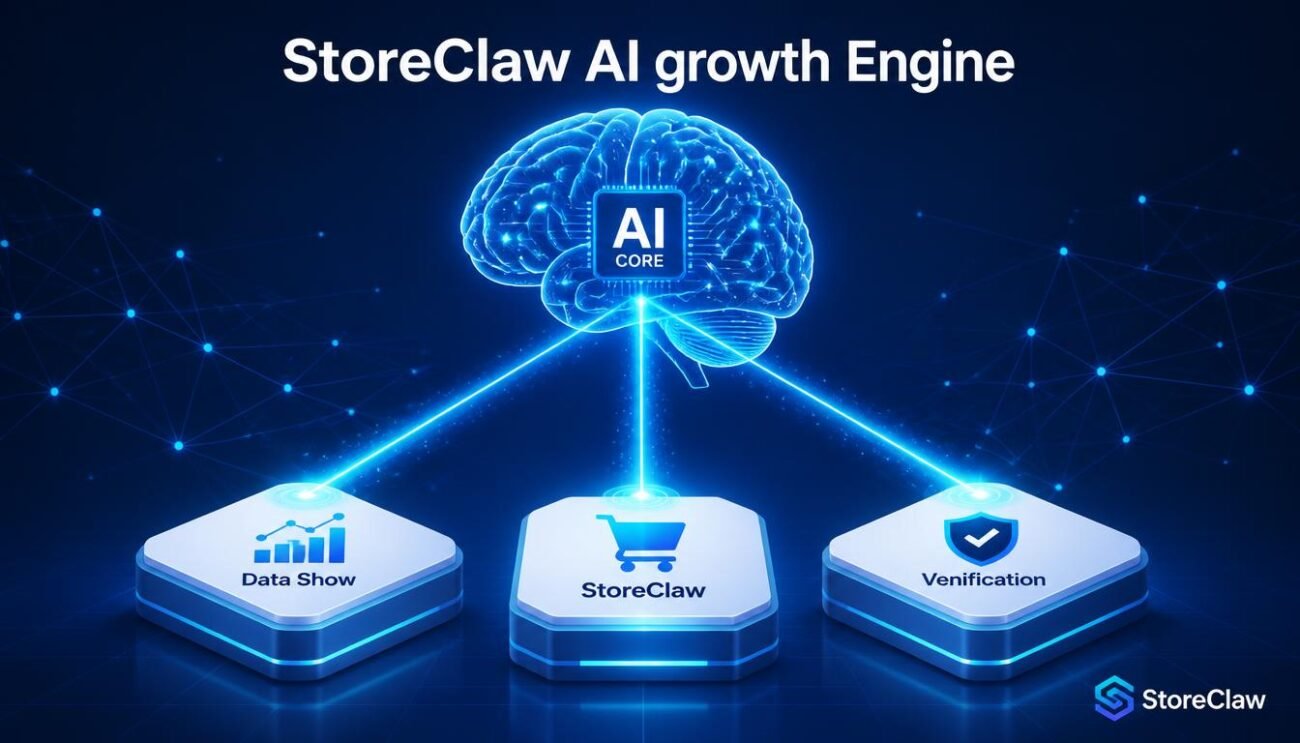
1. The Death of the Traditional E-Commerce Stack(StoreClaw)
The modern e-commerce landscape is broken. For over a decade, building a successful online retail brand required a highly complex, fragile ecosystem of software. A standard mid-market direct-to-consumer (DTC) merchant in the United States routinely patches together an array of disconnected systems: a core commerce platform (such as Shopify Plus, WooCommerce, or BigCommerce), an email automation suite (like Klaviyo), a customer service desk (like Gorgias), an analytics dashboard (like Google Analytics 4), and dozens of niche micro-applications for product reviews, upselling, subscriptions, cross-selling, size guides, and loyalty points.
This approach creates a severe structural bottleneck. Each software application runs on its own codebase, updates independently, and processes consumer data within its own isolated silo. To keep this fragile network of plugins functioning without breaking the user experience or destroying site load speeds, e-commerce brands must hire, manage, and retain an expensive internal technology team or pay premium retainer fees to specialized external digital agencies.
For an emerging or mid-market enterprise generating between $2 million and $20 million in annual revenue, the financial burden of technical overhead is increasingly unsustainable:
- Full-stack developer salaries in the United States average $110,000 to $160,000 per year per engineer.
- Agency retainers consume an additional $5,000 to $15,000 every month.
- SaaS software subscription fees bleed thousands of dollars from gross margins before a single product is packaged or shipped.
Beyond the direct financial drain, the operational drag is immense. When an e-commerce brand wants to deploy a simple promotional campaign or test a new conversion optimization strategy, the workflow involves multiple stages of human friction:
- Marketing writes a creative brief.
- Graphic designers build mockups.
- Web developers write code and test it across browsers.
- QA engineers check for breaking bugs.
- Project managers schedule the deployment.
By the time a single promotional banner or product bundle goes live, weeks have passed, thousands of dollars have been spent, and a competitor has already captured the market trend. This is the Developer Dilemma.
At the same time, consumer acquisition costs (CAC) across major digital advertising networks—including Meta, Google Performance Max, and TikTok—have reached historic highs. Due to privacy rollouts like Apple’s iOS 14.5+ App Tracking Transparency framework and the ongoing depreciation of third-party cookies, traditional ad targeting algorithms have lost significant signal precision. Merchants can no longer solve growth problems simply by pouring more capital into ad platforms. Growth now depends on conversion efficiency, structural cost reduction, and maximizing customer lifetime value (LTV).
This economic reality requires an entirely new framework. Enter StoreClaw, a fully autonomous, zero-code, end-to-end artificial intelligence growth engine designed specifically to eliminate the need for human engineering teams, data analysts, and outsourced agencies. StoreClaw does not merely assist your business; it runs your front-end optimization, your predictive logistics, and your multi-channel marketing campaigns autonomously.
2. What is StoreClaw? The Architecture of an Automated Executive
StoreClaw replaces the traditional, fragmented web-app stack with a unified, centrally managed cognitive intelligence layer. Instead of forcing a merchant to log into fifteen separate software dashboards to understand their business, StoreClaw integrates directly into the baseline commerce database via a secure API and operates as a unified, automated executive system.
Architecturally, StoreClaw is divided into three primary software layers that perform the work of an entire executive team:
The Virtual CTO (Chief Technology Officer)
This subsystem continuously monitors and optimizes the digital storefront. It evaluates site infrastructure, cleans up redundant code, optimizes image rendering pipelines, patches security vulnerabilities, and restructures the frontend user interface layout in real-time. It completely removes the need for web developers or performance tuning engineers.
The Virtual CMO (Chief Marketing Officer)
This engine manages customer acquisition and retention. It analyzes customer behavior patterns across the storefront, writes highly effective advertising copy, designs marketing assets, launches multi-channel advertising campaigns, balances daily ad spending across networks, and deploys hyper-personalized lifecycle email and SMS workflows without any human intervention.
The Virtual COO (Chief Operating Officer)
This data processing engine connects directly with supply chain backends, enterprise resource planning (ERP) software, and third-party logistics (3PL) providers. It studies historical purchase trends, seasonality, localized weather data, macroeconomic trends, and digital browsing velocities to accurately predict inventory demand down to individual product variants (SKUs).
Unlike old-fashioned automation software that relies on fixed, rigid, human-coded “if-this-then-that” rules, StoreClaw operates on continuous feedback loops driven by reinforcement learning models. It observes every single mouse movement, scroll depth, click event, cart abandonment, and ad impression across your entire business ecosystem. It learns what drives conversions and profits for your specific brand and automatically adapts its code and strategy every second of the day.
3. Pillar 1: Autonomous Storefront Optimization (The No-Code Frontend)
When a human user lands on a traditional e-commerce website, they experience a static template. Whether the visitor is a 22-year-old tech-savvy consumer browsing on an iPhone 15 Pro Max from a high-speed 5G network in New York City, or a 65-year-old consumer using an old desktop computer on a slow broadband connection in rural Ohio, they see the exact same layout, the same navigation menu, and the same product hierarchy.
This rigid approach severely hurts conversion rates. StoreClaw eliminates static websites by introducing Autonomous Storefront Optimization. When a visitor clicks onto a StoreClaw-powered site, the AI customizes the storefront interface specifically for that individual user in milliseconds, without slowing down the site’s performance.
Real-Time User Interface Tailoring
StoreClaw adjusts the interface on the fly based on user signals:
- The Navigation Menu: If the AI detects that a user is highly focused on specific categories based on initial clicks or referral data, it rearranges the main navigation to place those categories first.
- The Checkout Process: For a user who shows signs of hesitation or cart abandonment risk (such as moving the cursor toward the browser close button or pausing on shipping fees), the AI instantly simplifies the checkout layout, hides optional form fields, and moves the most trusted payment badges forward.
- Component Positioning: Elements like review widgets, sizing charts, and value propositions automatically move up or down the page depending on what that specific user profile needs to see to complete a purchase.
Zero-Human A/B Testing
Traditional conversion rate optimization (CRO) requires marketing teams to run split tests for weeks. They must manually set up variants, wait for statistical significance, analyze charts, and then ask a developer to push the winning design to production.
StoreClaw changes this entirely. The AI runs thousands of continuous micro-tests simultaneously across small groups of visitors. It tests subtle variations in headline copy, button colors, product image sequences, spacing, and call-to-action text. When the system identifies a design variation that improves conversions, it automatically updates the live website for that specific audience segment. It updates its own code without needing a human to write a single line of CSS or JavaScript.
Advanced Speed Optimization
Site speed directly impacts revenue. Studies show that every additional second of page load time reduces conversion rates by up to 7%.
StoreClaw’s Virtual CTO layer acts as a permanent, automated speed specialist. It implements machine-learning script prioritization: non-essential background scripts are automatically paused until the user finishes interacting with the main page elements.
The AI compresses media assets dynamically, uses smart browser pre-fetching to load the next likely page before the user clicks it, and cleans out broken code left behind by old apps. This keeps mobile performance metrics in the high 90s on Google Lighthouse, giving brands a major advantage in search engine rankings (SEO) and lowering bounce rates.
4. Pillar 2: Predictive Inventory & Smart Supply Chain Management
While front-end optimization captures customer demand, back-end operations protect profit margins. Mismanaging inventory kills e-commerce brands in two ways:
- Stockouts: Running out of popular items means losing revenue and pushing customers straight to competitors.
- Overstocking: Buying too much inventory ties up critical cash flow in unsold goods that eventually must be liquidated at a loss.
StoreClaw solves this balance with a predictive data engine that connects storefront trends directly to supply chain management.
Multi-Variable Demand Forecasting
Old-school inventory systems only look at past sales data to guess future needs. StoreClaw uses far more advanced, multi-variable forecasting models. The AI evaluates historical sales velocity and combines it with external real-world data points:
| Internal Data Sources | External Data Inputs |
|---|---|
| Real-time add-to-cart trends | Localized weather forecasts |
| Direct search query volume | Regional macroeconomic trends |
| Wishlist growth rates | Social media virality indicators |
| Abandoned cart recovery speeds | Competitor pricing shifts |
If a specific product style begins trending on social networks in the Northeast United States, StoreClaw detects the surge in early signals—long before it shows up as an official sale. It calculates the exact regional demand acceleration and gives the merchant early warning signals.
Auto-Replenishment & Capital Efficiency
StoreClaw doesn’t just alert you to inventory problems; it helps fix them. The engine calculates the exact reorder points for every individual product variation (SKU), factored against variable manufacturer lead times and shipping delays.
When stock drops below safety margins, the AI automatically drafts precise purchase orders (POs) with the correct quantities and sends them to your operations team or directly to suppliers via integrated EDI portals. By keeping stock tightly aligned with real-time demand, brands can reduce capital tied up in warehouses by 30% to 45%, freeing up massive cash flow to reinvest back into growing the business.
Intelligent Dynamic Pricing
Fixed pricing model strategies often miss out on easy profit margins. StoreClaw includes an automated dynamic pricing engine that safely updates prices to maximize total gross profit.
When inventory is high and demand is slowing, the AI introduces smart, targeted discounts to move stock quickly. When stock is low and demand is high, it adjusts prices upward to capture more profit per unit and slow down sales just enough to prevent a total stockout before the next shipment arrives.
5. Pillar 3: Omni-Channel Marketing Automation (The Automated CMO)
Paying digital marketing agencies to manage Facebook ads, Google campaigns, and email sequences is often one of the biggest drains on an e-commerce brand’s budget. StoreClaw replaces these agencies with an Omni-Channel Marketing Engine that plans, builds, launches, and optimizes marketing campaigns completely on its own.
Automated Creative Generation and Copywriting
Writing ad text, designing headlines, and setting up marketing hooks usually takes teams of copywriters days of back-and-forth work. StoreClaw uses highly advanced natural language generation models trained specifically on top-performing DTC ad frameworks.
The AI looks at a product’s features and instantly generates hundreds of tailored ad variations for Meta, Google, and TikTok. It writes professional copy matching your exact brand voice, creates matching graphic layouts, and formats everything to fit each social network’s unique style.
Algorithmic Ad Buying and Budget Shifts
Human media buyers often struggle to keep up with fast-changing ad platforms. They check ad managers a few times a day, look at old data, and make emotional budget choices. StoreClaw’s programmatic ad-buying engine monitors performance metrics every single minute:
If a specific ad asset on TikTok sees a sudden spike in Return on Ad Spend (ROAS) at 2:00 AM, StoreClaw shifts budget into it immediately to maximize the trend. If a Facebook ad campaign’s conversion costs jump past profitable limits, the AI turns it off right away. This constant, unemotional adjustments protects ad budgets and prevents ad waste.
True Hyper-Personalized Lifecycle Retention
Most brands group their email and SMS marketing into a few basic buckets (like a standard 3-day welcome sequence or a basic abandoned cart reminder). StoreClaw treats every single customer as an independent marketing channel.
The system builds custom customer profiles based on precise tracking: product usage cycles, precise times they open emails, click behaviors, and historical order frequencies. If a customer typically buys a product refill every 45 days on a Sunday morning, StoreClaw delivers a personalized SMS reminder exactly at 9:15 AM on day 44 with a one-click checkout link. This hyper-targeted approach dramatically increases repeat purchase rates and drives up overall Customer Lifetime Value (LTV) without needing a marketing team to manage complex segmentation lists.
6. Head-to-Head Comparison: StoreClaw vs. Traditional Infrastructure
To truly understand how StoreClaw changes e-commerce operations, we need to compare it directly against the traditional approach across key business performance metrics.
| Performance Vector | Traditional Infrastructure Setup | The StoreClaw Autonomous Model |
|---|---|---|
| Engineering Support | Requires multiple expensive frontend/backend engineers or agencies. | Zero developers required. The system writes and deploys its own code adjustments. |
| Site Load Performance | Slows down as more apps and tracking pixels are piled on. | High performance. Clean, optimized code with smart asset delivery. |
| Ad Strategy Execution | Manual setups by media buyers that take days or weeks. | Real-time adjustments. Automated creative production and instant budget routing. |
| Logistics & Inventory | Basic alerts based on past sales; prone to human error. | Predictive supply chain. Deep data modeling builds purchase orders early. |
| System Maintenance | Constant updates, broken plugins, and unexpected site crashes. | Self-healing infrastructure. Continuously checks for errors and fixes bugs itself. |
| Data Collection | Fragmented data scattered across a dozen separate analytics apps. | Unified data platform. All customer signals feed into one central decision engine. |
7. Strategic Implementation: Onboarding and Operational Integration
Moving your entire e-commerce infrastructure over to an autonomous system might feel overwhelming, but StoreClaw’s setup process is designed to prevent any business disruption or downtime.
Phase 1: Safe Import and Data Sync
Integration starts with a simple, secure API connection to your existing e-commerce setup (like Shopify Plus or BigCommerce). During this initial phase, StoreClaw imports historical data from the past 24 to 36 months, including product catalogs, customer purchase patterns, tracking logs, and past advertising metrics. This sync happens completely in the background without affecting your live site or customer experience.
Phase 2: Shadow Mode Learning
Before taking any actions, StoreClaw runs in a passive Shadow Mode for 7 to 14 days. During this time, the AI system does not change code, modify prices, or alter live ad campaigns. Instead, it observes daily operations, analyzes traffic patterns, and builds specialized local models tailored directly to your specific customer base. The system profiles your buyers, flags leaks in your conversion funnel, and builds its initial demand forecasts.
Phase 3: Gradual Deployment and Testing
Once the learning phase finishes, StoreClaw slowly begins turning on features through an adjustable confidence slider. The business owner retains total control over how fast the AI takes over:
- Week 1: The AI starts running subtle design optimizations on product pages and handles minor bid adjustments on Google and Meta campaigns.
- Week 2: The system activates dynamic product recommendations, deploys personalized email/SMS sequences, and takes over full ad campaign creation.
- Week 3: Full predictive inventory dashboards go live, and dynamic checkout optimization turns on to maximize conversions.
Phase 4: Full Autonomy and Scalability
By the fourth week, the system runs on autopilot. StoreClaw handles the daily tech work, optimization routines, and data management. Instead of spending their days fixing broken plugins or checking spreadsheets, your executive team can focus on what matters most: product development, wholesale expansion, brand identity, and long-term business strategy.
8. Financial ROI Projections: The Core Unit Economics
Investing in StoreClaw isn’t just about adding new technology; it completely restructures your brand’s profit and loss (P&L) statements. By cutting out engineering salaries, reducing ad spend waste, and unlocking hidden conversion opportunities, the financial impact directly boosts your bottom line.
Let’s look at the financial performance shift for a typical US e-commerce brand generating $5,000,000 in annual revenue:
The Traditional Overhead Cost Structure
- Frontend Agency Retainer: $96,000 per year ($8,000/month)
- Dedicated Data/Growth Contractor: $72,000 per year
- SaaS Plugin App Subscriptions: $34,000 per year
- Ad Spend Waste (Inefficient bids/creative): $115,000 per year
- Inventory Capital Losses (Overstock/Stockouts): $140,000 per year
- Total Operational Drag: $457,000 annually
The StoreClaw Cost Structure
- StoreClaw Unified Platform License: Combined into one predictable monthly fee.
- Human Engineering/Agency Overhead: $0
- SaaS Plugin App Costs: $0 (Replaced by StoreClaw’s native features)
- Ad Spend Waste Reduction: Reduced by up to 80% via algorithmic tracking.
- Inventory Efficiency Gains: Reclaims up to 40% of tied-up warehouse cash flow.
Traditional Tech Overhead: [====================================] $457k/yr
StoreClaw Model:           [======] (Saves 70-80% in operational drag)
By removing external software friction and human delays, brands using StoreClaw typically see immediate, measurable improvements across core business metrics:
- Average Conversion Rate (CVR): Increases by 22% to 38% within the first 90 days.
- Customer Lifetime Value (LTV): Grows by 18% to 30% through hyper-personalized marketing.
- Gross Margins: Expand by 400 to 850 basis points due to reduced tech stack expenses and better inventory management.
9. Future-Proofing for the Autonomous Commerce Era
E-commerce is moving faster than ever. The old way of running an online store—managing a complex web of plugins, dealing with slow development cycles, and relying on manual data analysis—cannot keep pace with an AI-driven market. Brands that continue to rely on human engineering teams to handle basic day-to-day optimizations will increasingly struggle against competitors operating at digital speeds.
StoreClaw levels the playing field. It gives growing, mid-market enterprises access to the same advanced automation, predictive logistics, and hyper-personalized marketing infrastructure used by retail giants like Amazon, Walmart, and Target—all without needing a massive tech budget or an in-house development team.
By combining front-end customer experience, backend operations, and cross-channel marketing into one cohesive, self-improving platform, StoreClaw removes the technical barriers to growth. The future of online retail belongs to autonomous business models. With StoreClaw, your brand can step into that future today—building a faster, more agile, and highly profitable enterprise completely free from traditional tech debt.
(FAQ)
1. What exactly is StoreClaw, and how does it replace a technical team?
StoreClaw is an autonomous software ecosystem that acts as your brand’s virtual CTO, CMO, and COO. Instead of requiring human engineers to manually write code, fix bugs, run split tests, or patch software plugins, StoreClaw’s central intelligence engine writes, tests, and deploys front-end code optimization changes directly to your live storefront in real-time based on machine-learning feedback loops.
2. Will installing StoreClaw slow down our e-commerce site?
No. Unlike traditional software add-ons that pile heavy JavaScript code onto your pages and hurt performance, StoreClaw completely replaces your fragmented app stack. It acts as a single, optimized data processing layer that uses edge computing, intelligent script prioritization, and asset compression to keep mobile page speeds consistently in the high 90s on Google Lighthouse metrics.
3. How does the automated ad-buying system prevent overspending?
The platform features an algorithmic media-buying engine that monitors core tracking signals—including Return on Ad Spend (ROAS), Customer Acquisition Costs (CAC), and click-through velocities—every single minute across Meta, Google, and TikTok. If a campaign’s conversion performance drops below your predetermined baseline targets, StoreClaw turns it off immediately to save your budget, rather than waiting for a human media buyer to check the account hours or days later.
4. Can StoreClaw prevent our store from running out of stock?
Yes. StoreClaw goes beyond looking at basic internal historical sales charts. The Virtual COO subsystem combines your real-time add-to-cart trends and browse behaviors with external real-world indicators like regional weather trends, economic changes, and social media patterns to accurately predict buying demand down to the individual SKU level up to 90 days in advance, drafting precise purchase orders before a stock shortage happens.
5. Is our sensitive customer and business data safe with this platform?
Security is a core priority of the StoreClaw infrastructure. The engine connects with your baseline e-commerce platform via fully encrypted enterprise-grade APIs. It operates strictly within modern international data compliance guidelines, including GDPR and CCPA protocols, meaning your private financial data, backend supply chain pricing, and customer records remain completely secure, locked, and fully protected against leaks.
